Fastener Materials
The material of a fastener determines its strength, corrosion resistance, appearance and suitability for different environments. Selecting the correct material ensures long‑term performance, safety and compliance with engineering requirements.
The examples below cover the materials offered by FastenerFix across machine screws and bolts. Each provides different mechanical properties and levels of corrosion resistance depending on the application.
Common Fastener Materials
These materials represent the most widely used options in engineering, construction, manufacturing and general‑purpose fastening. Each has distinct advantages depending on strength requirements and environmental exposure.
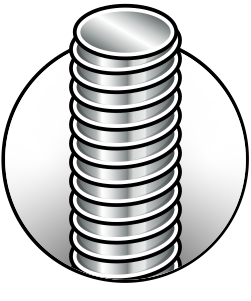
A versatile, low‑carbon steel used for general‑purpose fasteners. Offers good strength, easy machining and reliable performance in indoor or low‑corrosion environments. Often supplied with zinc plating for added protection.
Typical composition: ~0.05–0.25% carbon, small amounts of manganese and silicon, balance iron.
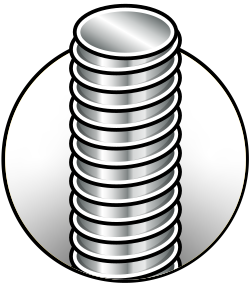
A medium‑carbon alloy steel used for structural and load‑bearing applications. Provides a strong balance of tensile strength and toughness, making it the standard choice for most engineering bolts.
Typical composition: ~0.25–0.45% carbon with manganese; quenched and tempered.
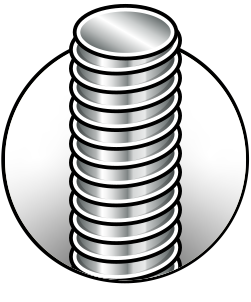
A high‑strength alloy steel offering significantly greater tensile and yield strength than 8.8. Used where higher clamping force, reduced bolt size or improved fatigue resistance is required.
Typical composition: ~0.30–0.50% carbon with chromium, molybdenum or boron.
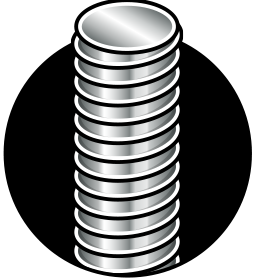
An ultra‑high‑strength alloy steel used in demanding mechanical, automotive and precision assemblies. Provides maximum tensile performance but is not suitable for corrosive environments without additional coating.
Typical composition: ~0.35–0.50% carbon with chromium and molybdenum; fully quenched and tempered.
A corrosion‑resistant stainless steel suitable for most outdoor, food‑safe and general‑purpose applications. Non‑magnetic in most forms and ideal where appearance and durability are important.
Typical composition: ~18% chromium, ~8% nickel, low carbon; excellent general corrosion resistance.
A marine‑grade stainless steel with enhanced resistance to chlorides, chemicals and harsh environments. Used in coastal, industrial and hygiene‑critical applications where long‑term corrosion protection is essential.
Typical composition: ~16–18% chromium, ~10–14% nickel, 2–3% molybdenum for chloride resistance.
A copper‑zinc alloy offering excellent corrosion resistance, electrical conductivity and a decorative finish. Commonly used in electrical fittings, plumbing, instrumentation and applications requiring a non‑sparking material.
Typical composition: ~60–70% copper, ~30–40% zinc; may include small amounts of lead for machinability.
Mechanical Properties Comparison
| Material | Tensile Strength | Corrosion Resistance | Magnetic | Typical Applications |
|---|---|---|---|---|
| Mild Steel | Low–Medium | Low (improved with plating) | Yes | General indoor fastening, light engineering |
| Grade 8.8 | Medium–High | Low (improved with plating) | Yes | Structural bolts, machinery, automotive |
| Grade 10.9 | High | Low (improved with coating systems) | Yes | High‑load joints, suspension, heavy machinery |
| Grade 12.9 | Very High | Low (improved with coating systems) | Yes | Precision assemblies, critical mechanical joints |
| A2 Stainless (304) | Medium | High | No (generally) | Outdoor, food‑safe, architectural |
| A4 Stainless (316) | Medium | Very High | No (generally) | Marine, chemical, hygiene‑critical |
| Brass | Low–Medium | High | No | Electrical, plumbing, decorative fittings |
Material Chemistry Table
| Material | Principal Elements | Notes |
|---|---|---|
| Mild Steel | Iron, Carbon, Manganese, Silicon | Low‑carbon steel with good ductility; often zinc‑plated for protection. |
| Grade 8.8 Steel | Iron, Carbon, Manganese, Chromium, Boron (trace) | Medium‑carbon alloy steel; quenched and tempered for strength. |
| Grade 10.9 Steel | Iron, Carbon, Chromium, Molybdenum, Manganese | Higher alloy content improves hardenability and fatigue resistance. |
| Grade 12.9 Steel | Iron, Carbon, Chromium, Molybdenum, Manganese | Ultra‑high strength; requires precise heat treatment. |
| A2 Stainless (304) | Iron, Chromium, Nickel, Manganese, Silicon | Austenitic stainless; excellent general corrosion resistance. |
| A4 Stainless (316) | Iron, Chromium, Nickel, Molybdenum, Manganese, Silicon | Marine‑grade stainless; molybdenum improves chloride resistance. |
| Brass | Copper, Zinc, Lead (trace) | Corrosion‑resistant, conductive, non‑sparking alloy. |
Chemical Composition Comparison
| Material | Carbon (C) | Chromium (Cr) | Nickel (Ni) | Molybdenum (Mo) | Other Elements |
|---|---|---|---|---|---|
| Mild Steel | 0.05–0.25% | — | — | — | Iron (balance), Manganese, Silicon, trace Sulphur / Phosphorus |
| Grade 8.8 | 0.25–0.45% | 0–1% | — | 0–0.3% | Iron (balance), Manganese, Boron (trace) |
| Grade 10.9 | 0.30–0.50% | 0–1.5% | — | 0.2–0.6% | Iron (balance), Manganese, Vanadium |
| Grade 12.9 | 0.35–0.50% | 0–1.5% | — | 0.3–0.8% | Iron (balance), Manganese, Vanadium |
| A2 Stainless (304) | ≤0.08% | 18% | 8% | — | Iron (balance), Manganese, Silicon |
| A4 Stainless (316) | ≤0.08% | 16–18% | 10–14% | 2–3% | Iron (balance), Manganese, Silicon |
| Brass | — | — | — | — | 60–70% Copper, 30–40% Zinc |
In carbon and alloy steels, increasing carbon content directly increases strength by enabling deeper hardening during heat treatment. However, higher carbon also reduces ductility and weldability. Mild steels (0.05–0.25% C) remain soft and formable, while high‑strength grades such as 10.9 and 12.9 (0.30–0.50% C) achieve very high tensile strength after quenching and tempering. Stainless steels rely on chromium and nickel for corrosion resistance, so their carbon content remains low.